
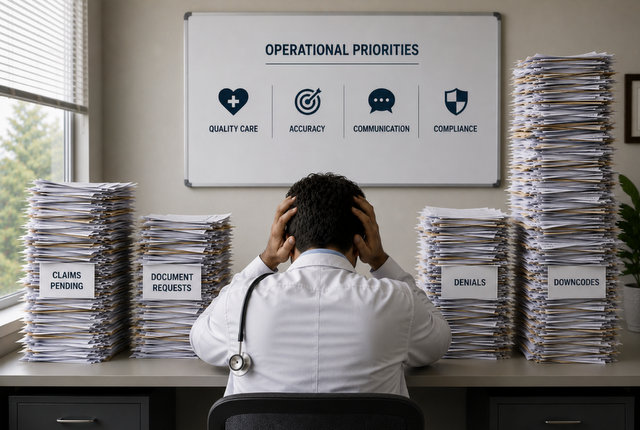
A history of the LANE diagnosis lists, why they are a poor coding tool, and how documentation can help prevent the downcode.
A clinician evaluates a patient who had a syncopal event. After thorough exam revealing a murmur, she orders blood work, ECG which she interprets, urinalysis and echocardiogram. The patient is found to have a urinary tract infection but an otherwise benign workup.
The patient is happy with the good news and the discharge home to treat her UTI. Weeks later, the patient’s insurance quietly pays at a level 3 instead of the level 5 that is well supported, with a note that the diagnosis was “low acuity non-emergent”. The LANE list has struck again. But is this really a big deal?
Why does this downcoding matter?
Although the loss of appropriate reimbursement on one chart may seem like a minor issue, it may compound brutally at scale. For just one facility contract, this loss adds up quickly.
Even using a lower average commercial reimbursement at twice Medicare for one facility seeing 100 patients per day with just 10% downcoding of only level 5 encounters; the loss would surpass a quarter of a million dollars in under a year. And keep in mind, some payers have significantly higher downcoding rates, and do not limit their dirty deeds to just level 5 downcoding. Fighting back starts with understanding the misuse of the LANE tool and how documentation can help.
What LANE means, and its origin story
LANE stands for Low Acuity Non-Emergent. The LANE list includes ICD-10 diagnosis codes believed to represent conditions that do not require immediate evaluation or treatment. When one of these diagnosis codes is listed as the diagnosis for a patient encounter, the payer might quietly downcode the encounter to a lower level regardless of the clinician’s work to get there.
The original LANE list most often sited is the Mercer LANE list created in 2019. But before you grab a pitchfork, know that Mercer created this list to help states control costs in the Medicaid and Medicaid Managed Care space by promoting primary care access, chronic care coordination, improved EHR integration, transportation, enrollee education, and improved payment strategies to promote alternate ED settings.
This is a clear emphasis by Mercer on carrots, not sticks. The LANE list was not created to penalize emergency clinicians for taking care of our vulnerable Medicaid population, that leap was made by commercial payers. Are we surprised?
To add insult, Mercer is an actuarial human resources and benefits consulting firm, not a healthcare organization. The repurposing of their product by commercial payers as an automated downcoding mechanism is using the wrong tool for a coding job its creators do not claim to understand.
Of course, sorting ED visits by diagnosis did not start with Mercer. The idea grew from a far more appropriate instrument, and that history is also worth knowing.
The Billings/NYU algorithm, at the turn of the century
In the late 1990s, John Billings and two colleagues at New York University set out to answer a question that healthcare researchers had never been able to pin down: of all the patients presenting to the emergency department, how many are true emergencies, and how many were people who could not get care elsewhere?
Working with emergency physicians, they reviewed roughly 5,700 ED discharge abstracts to sort visits into categories: Non-emergent, Emergent but treatable in a primary care office, Emergent and needing the ED but avoidable with earlier care, and unavoidable Emergent. The results came out as Commonwealth Fund issue briefs in 2000.
What made this different then LANE? The NYU algorithm is based on probability, assigning each diagnosis a fractional weight for each category. Thus, a diagnosis might represent forty percent non-emergent, thirty percent primary-care treatable, thirty percent emergent. Those weights applied to the whole population not an individual. No one involved in this research asserted it could adjudicate your claims for individual patients, quite the opposite.
Why LANE should never be used as a coding tool
The move from Billings/NYU population research to a claims engine is where the process becomes absurd.
Payment for diagnoses, not for work – In my prior article, I explained the difference between ICD-10 codes and CPT codes, the former reflects diagnoses, the ladder reflects your work. Each year CMS releases its physician fee schedule and assigns relative value to our work through CPT codes, not ICD-10 codes. Any process that rewards or penalizes clinicians based on what we diagnose promotes high acuity assumptions and devalues quality care.
A population tool used on the individual – A weight describing a cohort cannot decide a single case. When a payer changes a probability to all-or-none, it has made a grave statistical mistake. Imagine the assumption that patients with chest pain are never having emergent cardiac events since most patients with chest pain are not having an emergent cardiac event.
That would make our lives much easier, but that’s not reality. Thankfully, emergency clinicians are very aware of that fact and understand probability. CPT also states that even a low probability of death may be high risk, the AMA clearly understands probability also. A LANE list would have you believe that a low probability of death is equivalent to a non-emergent encounter since most patients wouldn’t die. I suppose they are willing to break a few eggs for their cost-saving omelet.
It penalizes an underserved population – Mercer’s list was built for Medicaid managed-care oversight, which Mercer frames by noting Medicaid beneficiaries used the ED at nearly a twofold higher rate than their private insured counterparts. This connects the issue of ED over utilization by Medicaid patients with a list of apparent low acuity diagnoses. Although Mercer points to multiple opportunities to improve access to care, commercial payers have done the opposite, utilizing these diagnoses to penalize the ED clinicians for providing such access.
It contradicts the 2023 E/M guidelines – As I have mentioned in a prior article, The 2023 revisions tied ED code selection to medical decision-making. This includes the complexity of problems addressed, the data reviewed, and how much risk you carried in management. Diagnosis-based downcoding has no place in CPT coding or CMS guidelines. Judging the chart on its closing code ignores the entire medical decision making that was required to get there.
It is an affront to prudent layperson standard – Federal and state prudent layperson rules state that coverage depends on the patient’s presenting symptoms as a reasonable layperson would view them, not on the emergency medicine expert’s diagnosis after workup. A downcode driven by the final diagnosis is a retrospective denial of the acuity the presentation called for. This runs afoul of the principle that has governed emergency coverage for decades.
A Documentation Assist
Though the fight against LANE downcoding lists should continue with relentless intent for as long as they exist, there are actions that may help prevent or reverse these downcodes today.
First, LANE lists focus on diagnosis but appeals are won on the body of the chart. Appealing these downcodes is your best initial weapon when your documentation shows the true encounter complexity and risk by highlighting presenting symptoms, emergent diagnoses ruled in or out, the workup undertaken, and treatments provided.
Second, improving your final diagnosis accuracy may also help complete the picture and prevent the downcode before it happens. What steps can you take to improve your diagnosis documentation?
Give your greatest concern recognition – ICD-10 may prefer non-symptom, definitive diagnoses, but this may hide the presenting symptom that drove your entire workup. If a presenting symptom is not routinely associated with the eventual definitive diagnoses, it should be included as a diagnosis itself. Furthermore, if the only definitive diagnoses are incidental, the presenting symptom should be your primary diagnosis. “Hypertension” as a sole incidental definitive diagnosis when a patient presented for chest pain could stimulate a needless downcode that the diagnosis of “chest pain” could have prevented.
Definitive diagnoses can still help – sometimes the symptoms may not paint the whole picture. A definitive diagnosis may reflect the severity of symptoms and may overcome a likely downcode. “Nausea with vomiting unspecified” may be the presenting symptom, but the definitive “dehydration” shows the depth of suffering.
Be specific – uncertain or “.9” ICD-10 codes often make their way to LANE lists. Adding specificity in your diagnoses can avoid this trap. What quadrant was the abdominal pain located? What type of headache was it?
Unfortunately, there is no method of certainty to prevent all diagnosis downcoding today. When better diagnoses can’t prevent downcodes, appealing with good documentation is a necessity. But downcodes are often done quietly by payers, so payment tracking is an imperative for any revenue cycle management team. If you haven’t heard you are being downcoded, your team may not be looking.
The final move against final diagnosis downcoding
The LANE list is not a coding instrument nor was it born from rigorous investigation; it is a crude approximation of the thoughtful research found in the NYU algorithm. Diminished to lose all probability data, twisted to fit the individual, and corrupted to penalize those providing care to vulnerable patients.
The good news is that we have already seen similar diagnosis downcoding programs dismantled by the courts as was the case for Virginia Medicaid in 2023. But change takes time and these downcoding programs only succeed in the dark. Speaking out, providing examples to any professional group you subscribe to, and talking with policymakers can make a difference. Payers are using our patient focus to distract us from their underpayments. While quality care should always be the focus, simultaneously achieving appropriate reimbursement can be nearly achievable.
References
- Billings J, Parikh N, Mijanovich T. Emergency Department Use: The New York Story. Issue Brief (Commonwealth Fund). 2000 Dec;(434):1–12.
- Billings J, Parikh N, Mijanovich T. Emergency Department Use in New York City: A Substitute for Primary Care? Issue Brief (Commonwealth Fund). 2000 Nov;(433):1–5.
- Johnston KJ, et al. A “Patch” to the NYU Emergency Department Visit Algorithm. Health Serv Res. 2017;52(4):1264–1276.
- Mercer Government Human Services Consulting. Addressing the problem of low acuity in non-emergent ED visits. 2019. Accessed June 26, 2026. https://www.mercer-government.mercer.com/content/dam/mercer-subdomains/us-government/attachments/secured-fact-sheets/6009740b(21)-HB%20Addressing%20the%20Problem%20of%20Low%20Acuity%20in%20Non-Emergent%20ED%20Visits%20(LANE%20Sell%20Sheet)_V2c_AP_SEC.pdf